ESE’s commitment to empowerment and engagement of citizens in processes for planning, implementation and evaluation of legislation, budgets and services under the social accountability and legal empowerment approach was crowned with the formation of the European Community of Practitioners on Accountability and Social Action in Health – COPASAH. On the account of absence of any relevant data, a survey research was conducted on utilization of primary healthcare services among Roma people and populations living in rural areas and about environmental risks and impact thereof on health and living conditions for Roma. For that purpose, we applied the social and behavioural change methodology to practicing healthy lifestyles and life-cycle immunization of adult population. We continued to gather evidence on citizens’ needs in respect to facilitated access to justice, focusing on detailed analysis of women who have suffered domestic violence, which means that, in addition to ensuring resolution of their legal needs, efforts were also geared towards issues related to child support and economic independence of these women. Significant effort was invested in developing ESE’s social enterprise branded as POGON. As regards taking action in cases of domestic violence, we cooperated with police officers and inspectors taking initial action in such cases. On the account of its efforts for promotion of fiscal transparency, ESE became part of the Europe Beneficial Ownership Leadership Group that have made significant contribution for improving civic engagement in the country and will continue to work together on promoting civic engagement across Europe (under the OGP process).
In this period as well, ESE remained committed to promoting civic empowerment and engagement in processes for planning, implementation and evaluation of legislation, budgets and services under the social accountability and legal empowerment approach. For that purpose, we designed plans for continuous capacity building of staff members at partner Roma organizations, delivered training and advanced the process of mapping Roma communities for increased and holistic engagement of citizens in decision-making processes by developing additional criteria for community mapping. Another milestone in this period concerns training delivered by experts from the University of Seville, Spain, focusing on work in the field of improving Roma mental health, which is the first of this type. Capacity building work with public institutions in this period concerned the ability to engage and involve citizens in their operation. Cooperation with HOPS continued in the form of support to their efforts on access to public information; gathering data on the amount of funds collected on the basis of excises levied on beer, ethyl alcohol and cigarettes and designated for promotion of citizens’ health; gathering data on funds collected on the basis of custom duties, as well as fees for import, process and sales of cannabis and its products and how these funds had been spent. In cooperation with the Employment Service Agency, the Ministry of Labour and Social Policy and four partner organizations, we worked on promoting transparency and civic participation in the labour sector, and we worked on improving quality of and access to employment services for citizens, with focus on vulnerable groups.
In response to the global pandemic and the consequent state of emergency, efforts in 2021 were focused on assessing needs of Roma communities related to timely response and recovery at times of crisis, notably by conducting a survey research among 2 527 households in Roma communities in four municipalities (Shuto Orizari, Prilep, Gjorche Petrov and Karposh). This endeavour resulted in documentation of key problems faced by Roma communities and their ability for timely response and recovery at times of crisis, i.e. 58 photographs with text message (PhotoVoice). We formed three community councils that would work on developing response and recovery plans at times of crisis for Roma communities through participatory and proactive action (Shuto Orizari, Prilep, Gjorche Petrov and Karposh). This effort resulted in development of four such plans at local level.
In 2021 we formed the COPASAH Europe Network comprised of 16 civil society organizations from Macedonia, Serbia, Bulgaria, Romania, Hungary and Albania. The network is envisaged to serve as platform for building civil society capacity to apply the social accountability and legal empowerment methodologies in their work on improving the exercise of human rights by marginalized communities. This was followed by development of the network’s strategic operation in the same year. In the period 2022-2023, we worked on building capacity of domestic and regional civil society organizations, i.e. COPASAH Europe Network, whose secretariat is managed by ESE. We conducted a number of capacity building activities for network members, but also worked on popularizing the concepts applied by this network. In particular, we developed the network’s communication strategy together with other member organizations from North Macedonia, Montenegro, Romania and Albania and exchanged experiences on work with vulnerable groups of citizens. We actively participated in consultations organized around COPASAH Global’s Strategic Plan. Moreover, we delivered two trainings: one related to application of the social accountability methodology intended for civil society organizations from the country, Serbia, Montenegro and Romania, and another training on impact assessment methodology relating to environmental impact on the population’s living conditions and health, with special focus on vulnerable groups of citizens. Two training modules were developed and posted on the network’s website for interested parties to use them. To actualize particular issues of importance, in cooperation with practitioners from around the world, the network organized three webinars on topics such as: “Impact of the Crisis on Health Services for Women, with Emphasis on Marginalized Groups of Women”; “Creating Opportunities for Stakeholder Participation in Responding to Emergencies in the Region” and “Strategic Litigation”. Finally, we designed and published two newsletters of COPASAH Europe.
In 2022, we committed to data collection and conducting survey research in Roma and rural communities on utilization of primary healthcare service by Roma and populations living in rural areas. More specifically, the research focus was put on health of mothers and children, as well as mental health. Findings from the research conducted in Roma communities were presented in the publication “When Life on the Margins of Society Determines Health: Access to Primary Healthcare for Roma People in the Republic of North Macedonia”, while findings from the research conducted in rural areas were published in the publication “When the Place of Residence Determines Health: Access to Primary Healthcare for People Living in Rural Areas in the Republic of North Macedonia”. The research targeting mental health relied on cooperation with renowned experts on Roma mental health from Europe. We collected data on environmental risks and their impact on living conditions and health of Roma people and tested utility and applicability of WHO’s Guide on Engaging Roma Communities in Contact Tracing. Findings from the survey research on environmental risks to Roma health are presented in the publication “Life on the Periphery: Study on Exposure to and Impact of Ecological Risks on Living Conditions and Health of Roma”.
We continued activities on monitoring implementation of preventive healthcare programs. A 2021 research study focused on consequences created by inconsistent implementation of uterine cancer screening relative to women’s mortality and quality of life, as well as costs falling on the burden of women and the state. Research findings and recommendations to promote screening activities are contained in the publication “Cost of the Failure to Organize Uterine Cancer Screenings”. In 2022, we developed three monitoring reports for two preventive healthcare programs (uterine and breast cancer screening) and one monitoring report for the Program for Active Health Protection of Women and Children, followed by pilot research in 2023 focusing on functionality of the electronic system for scheduling gynaecological examinations with PAP test, which is part of the Program on Uterine Cancer Screening, including two media releases (one video and one printed story) underlining inconsistencies in implementation of preventive healthcare programs, which were submitted to competent authorities together with a request for improved performance of these programs.
We participated and contributed to various important national processes and international events. At national level, we participated in development of the Strategy on Roma Inclusion 2022–2030, as well as 2023 and 2024 Programs for Active Health Protection of Mothers and Children. Furthermore, we participated at conferences organized for promotion of the Program or Uterine Cancer Screening to improve the healthcare system in North Macedonia and made significant contribution thereto. As member of the European Roma Health Network, we contributed in development of recommendations aimed to improve implementation of Roma Inclusion Strategies by EU member-states and candidate countries. We developed a shadow report to the Convention on the Rights of the Child relating to health of children and pregnant women, and shadow report to the UN Universal Periodic Review relating to the right to health and access to healthcare for Roma people, women and rural populations.
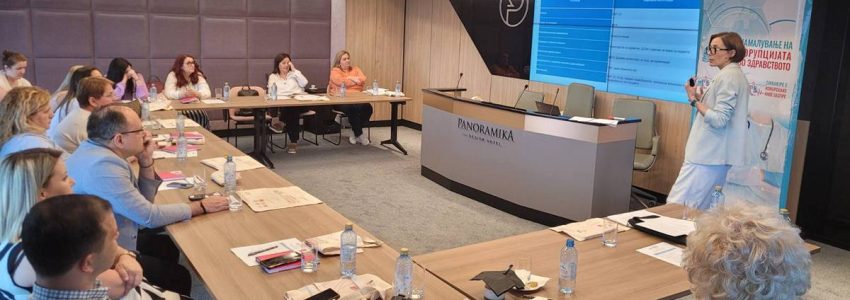
In 2023, efforts were dedicated to advancing the population’s health by applying social and behavioural change methodologies for practicing healthy lifestyles and life-cycle immunization of the adult population. In that vein, we trained 200 health workers (medical doctors, nurses and pharmacists) to apply these methods in their work to promote healthy lifestyles and increase coverage of their patients with vaccines. We delivered health education to 843 citizens on healthy lifestyles and importance of life-cycle immunization among adults, by applying the social and behavioural change methodologies. At the same time, we distributed 2 043 health education materials in the form of mini posters with content on healthy lifestyles and need for regular immunization of the adult population. A total of 7 966 SMS messages were sent to citizens and health workers featuring educational information aimed at promoting healthy lifestyles and regular immunization of the adult population. In the same vein, we organized a workshop with representatives from healthcare institutions to identify barriers to higher vaccine coverage among children and adult populations and designed measures to improve the overall immunization rate.
We worked on promoting health and healthcare of Roma population. For that purpose, efforts were made to identify barriers and problems faced by Roma women when accessing reproductive health services, as well as barriers and problems faced by mothers and children in Roma communities when accessing preventive healthcare service, followed by publication titled “Status of Reproductive Health and Health of Mothers and Children in Roma Communities”. We provided assistance in drafting written advocacy demands for improving access to primary healthcare for Roma in Shuto Orizari and advocated before the Deputy Prime Minister, Minister of Health and Chairman of the Health Committee at the Parliament for increased coverage of Roma population with COVID-19 vaccines in the early rollout of the nation-wide vaccination effort. In 2023, expert support was secured for partner Roma organizations for creating Roma Community Scorecards used to assess access to and quality of primary healthcare and preventive healthcare for women, mothers and children. Moreover, we provided assistance for development of local advocacy strategy focused on improving access to primary healthcare for Roma and improving access to preventive healthcare for women, mothers and children. This was followed by advocacy activities aimed at improving healthcare services for citizens in the Municipality of Shuto Orizari, which included a petition and presentation of demands for competent institutions to increase the number of healthcare services offered at the Policlinic in Shuto Orizari and to increase the number of registered general physicians, specialist and consultation healthcare services, X-ray and laboratory cabinets. We worked on enhancing capacity of partner Roma organizations to conduct a research in Roma communities by organizing a separate training for that purpose.
We worked on building capacity of civil society organizations, paralegals and young lawyers to resolve issues relating to access to justice for vulnerable groups of citizens. Two e-training modules were designed and intended to be used by paralegals, followed by training of 12 young lawyers to work on resolution of legal problems relating to domestic violence. We contributed to development of the Global Legal Empowerment Network – NAMATI’s Gender-Responsive Strategy on Access to Justice, notably by facilitating meetings with civil society representatives at national and regional level (Greece, Albania, Bulgaria and Bosnia and Herzegovina) to discuss priority areas for promotion of women’s status, opportunities for joint learning (capacity building) and advocacy at national, regional and international level. In cooperation with the Macedonian Association of Young Lawyers, we contributed to capacity building efforts for civil society organizations working in rural areas around issues relating to the UN Convention on Eliminating All Forms of Discrimination Against Women, especially by organizing training and mentorship for development of shadow report on actual status of women in rural areas.
In this period we continued to gather evidence on the needs of citizens in relation to facilitated access to justice. In 2021, we developed the report on implementation of SDG 16.3 based on previously designed set of indicators for monitoring state-of-play relating to the rule of law and equal access to justice. We developed a cost and benefit analysis on provision of free legal aid in 2021. With help from women affected by this issue we were able to identify costs incurred for initiating and leading necessary court proceedings. Another subject of analysis was child support, i.e. the need for such support and the amount set by courts. We expanded the field of research and started collecting data on loss of jobs and decreased earnings by women, health-related costs, costs relating to change of residence and other expenses faced by women as a result of domestic violence. In 2022, another cost and benefit analysis was focused on free legal aid for women who have suffered domestic violence, completing the cycle of this type of annual analyses initiated back in 2017.
In 2023, ESE’s work accounted for significant contribution in reporting state-of-affairs at international level. More specifically, we submitted a shadow report to the UN Universal Periodic Review covering a myriad of issues, including violence against women and domestic violence, access to primary healthcare for vulnerable groups of citizens such as women, Roma, rural populations. A written submission was made towards the report “The Promise of Legal Empowerment in Advancing Access to Justice for All” developed by the Un Special Rapporteur on Independence of Judges and Attorneys. Another milestone contribution was made in respect to the Word Bank’s 2023 special report “Women, Business and the Law”, including written summary of the status of women in relation to gender-based violence, marriage and family, property relations, labour market, etc.
Work continued on providing necessary legal and psychological support for women who have suffered domestic violence, whereby 500 persons were provided legal aid and approximately 150 persons benefited from psychological support. Court representation was secured for 24 women to initiate and lead necessary court proceedings. In 2021, upgrades were made to the internet platform for legal advice to women who have suffered domestic violence – ASK FOR ADVICE – www.pobarajsovet.mk, by integrating a feature for written submissions necessary for resolution of legal problems related to domestic violence, making the platform available in Roma and Albanian language and enriching its content with videos on civil and criminal court proceedings for protection against domestic violence. At the same time, we organized a comprehensive campaign to raise public awareness, especially among women, about the nature of domestic violence and law-mandated protection mechanisms, and produced a short documentary video “Domestic Violence is Cruel Reality for Many Women and Children”, intended to actualize the issue of violence and the need for assistance and support for women who have suffered domestic violence.
We engaged in advocacy at regional and national level for interests of women who have suffered domestic violence. A shadow report was developed to the Istanbul Convention, in cooperation with the Coalition MARGINS, Open Gate and the University of Edinburgh’s International Law Initiative. ESE staff participated in round table discussions organized by the Monitoring Mechanism of the Istanbul Convention to evaluate action taken by state institutions and judicial authorities. As part of the national process within the Open Government Partnership, we advocated for development of rulebooks for data collection on gender-based violence and for adoption of separate commitment under OGP NAP 2024–2026 to intensify activities by competent ministries in the field of prevention and awareness raising among the general and expert public. We contributed in the process of amending the Criminal Code and changing standard operating procedures at social work centres in domestic violence cases. At the same time, we worked with practitioners that work on domestic violence cases. Two videos for practitioners were produced and focused on the civil protection system, featuring statements by civil court judge and attorney-at-law that underline key aspects of proceedings for issuing temporary protection measures and the criminal protection system, as well as statements by criminal court judge and MoI representative that underline key aspects of criminal proceedings led by the police, prosecution offices and courts. This was accompanied by development of e-training course for practitioners, intended to enhance their knowledge and skills for enforcement of national and international legislation when working on domestic violence and violence against women cases. A forum was organized in 2022 with representatives from the Ministry of Justice and basic court judges from Skopje, Veles and Radovish, to improve civil legal protection of women. In 2023, local forums were organized with practitioners from basic civil courts, social work centres, Ministry of Justice’s regional offices for free legal aid and civil society organizations from Kumanovo, Prilep and Bitola, to improve civil legal protection of women who have suffered domestic violence.
In 2021, we developed an analysis of police actions in domestic violence cases, based on expert interviews with 48 police officers from all 8 sectors of internal affairs, and 12 women who had previous experience with the police when reporting domestic violence, including recommendations aimed at improving police actions, i.e. conducting investigations and issuing urgent protection measures in domestic violence cases. Consequently, we organized two trainings for police inspectors and uniformed police offices to enhance their knowledge and skills on risk assessment and issuing urgent protection measures for women, as well as more efficient criminal proceedings for criminal offences relating to domestic violence. At the request of SEESAK, ESE made a significant contribution to the regional initiative for reduced use of firearms in domestic violence cases.
Together with women who have suffered domestic violence, we worked on their economic empowerment and fundraising for provision of legal aid through the social enterprise POGON. We conducted a needs analysis relating to education of women, which served as baseline for organization of several trainings for women to acquire skills, including business development and management. A milestone achievement in this endeavour concerns POGON’s outreach to 410 local artisans from North Macedonia and five countries in the region, including cooperation agreements signed with 15 artisans. Hence, POGON now includes 46 artisans and markets more than 394 different types of products. Revenue collected from this effort exceeded MKD 100 000, four times the amount collected in 2021. POGON as brand and its products, including those crafted by women who have suffered domestic violence, have reached out to 484 885 persons in North Macedonia. Being a unique sales platform, POGON contributed to economic empowerment of 16 women who have suffered domestic violence. In particular, we enabled five women who have suffered domestic violence to attend tailoring and sewing courses and involved at least 11 women in continuous training on techniques for crafting artisan jewellery, later engaged to produce a unique line of jewellery marketed on POGON. We developed a special jewellery line branded as “POGON – Unique”.
Work on capacity building of public institutions providing access to justice for citizens continued. We participated in the process for drafting the strategy and work program of the Commission for Prevention and Protection against Discrimination (CPPD), and organized an inception training for commission members. As part of the Anti-Discrimination Network, together with HOPS, we developed a performance report for the Commission for Prevention and Protection against Discrimination and recommendations to its improve its track record and ensure effective enforcement of the law.
Public awareness work in this period focused on the importance of fiscal transparency and the need for priority-based gender-responsive budgeting, including support for citizens and public institutions to promote fiscal transparency and achieve greater and lasting changes. We encouraged public debate and activism by securing information and education material in the field of fiscal transparency and priority-based budgeting, i.e. we published more than 650 pieces of information on ESE’s websites and social media handles, with an outreach of more than 1 million persons. We celebrated the International Access to Information Day, September 28th, with debates organized by the Agency for Protection of the Right to Free Access to Public Information. Together with the Employment Service Agency and the Ministry of Labour and Social Policy, we engaged 988 citizens from four municipalities (Tetovo, Shuto Orizari, Prilep and Kumanovo) in evaluation of access to employment services and developed a platform for publishing the implementation status of active employment measures in 2021. In the next period, we continued cooperation with the Employment Service Agency, the Ministry of Labour and Social Policy and the Ministry of Health aimed at establishing civic participation mechanisms and building capacity of employees at these institutions. In addition, we initiated cooperation with the Ministry of Environment and Spatial Planning. The digital platform for publishing real-time information on implementation of ESA’s active employment measures and policies designed by ESE (as commitment under OGP) was officially launched in 2023.
We continued long-standing efforts to evaluate fiscal transparency and accountability of public institutions. In 2021, we assessed active and reactive transparency of 95 public institutions through continuous monitoring of official websites hosted by 25 public institutions and evaluating 1 690 procedures on free access to information. In the same year, we collected data on implementation of 3 130 public procurement procedures organized by 62 public institutions in 2020 and 2021 and drafted 63 proposals to promote cost-effectiveness, efficiency and transparency in public procurement. These data were presented to 63 public institutions. In 2022, we developed three reports based on reactive transparency assessment of 70 institutions by addressing them with 1 690 freedom of information requests in 2021 and assessed proactive transparency of 25 public institutions and cost-effectiveness and efficiency of 2 081 public procurement procedures implemented by 62 public health institutions in 2021. In 2023, we worked on building trust and sustainability of all initiatives aimed at promoting fiscal transparency and promoted the concept of openness in public procurement with 62 institutions providing services for citizens in the field of social and economic rights by monitoring their public procurement procedures and drafting recommendations to address challenges identified. Also, we worked on promoting access to public information, with special focus on information of significance for measuring gender equality and exercise of rights by vulnerable groups of citizens by initiating freedom of information procedures; we worked on educating the public and institutions about the right to free access to information, proposed measures and activities for public institutions aimed at increasing the scope of information made publicly available, and for measuring proactive and reactive transparency of institutions, followed by development of corresponding annual reports.
We advocated for improved fiscal transparency. In particular, we contributed in organization of OGP Ministerial Meeting as part of the Government of RNM’s regular session held on April 13th, 2021. We announced the call for local governments to join OGP Local and helped the Municipality of Sveti Nikole to join this initiative in 2021. In the same year, we participated in development of several manuals, calls for proposals, rules of procedure, guidelines and indicators relating to development, implementation and monitoring of OGP Action Plan and performance of OGP working groups and OGP Coordination Council. ESE is member of the Governing Board of the OGP Civil Society Network and its representative was selected to serve a second term as member of OGP National Stakeholder Fourm. Moreover, we delivered training for 40 representatives from public institutions and civil society organizations involved in developing OGP 2021-2023 National Action Plan and, together with FOSM and the Centre for Civil Initiative, supported implementation and monitoring of OGP 2021-2023 Action Plan. The association co-chaired the OGP Council in the period 2021–2023 and coordinated the process for co-creation of civic participation measures and activities under OGP 2023-2026 Action Plan. ESE is part of the Europe Beneficial Ownership Leadership Group that has made significant contribution to promoting civic engagement in the country and will continue to work jointly on furthering civic participation across Europe (under the OGP process).